
Sultan Saodat Ensemble
The brick mausoleums of the Sayyids of Termez, a family burial ground that grew over several centuries up to the 17th.
Listen while you walk
This guide plays in the language you selected.
Audio recording coming soon
The recording for this language has not been added yet. The full script is below — you can read it now and the audio will appear here as soon as it is uploaded.
Script
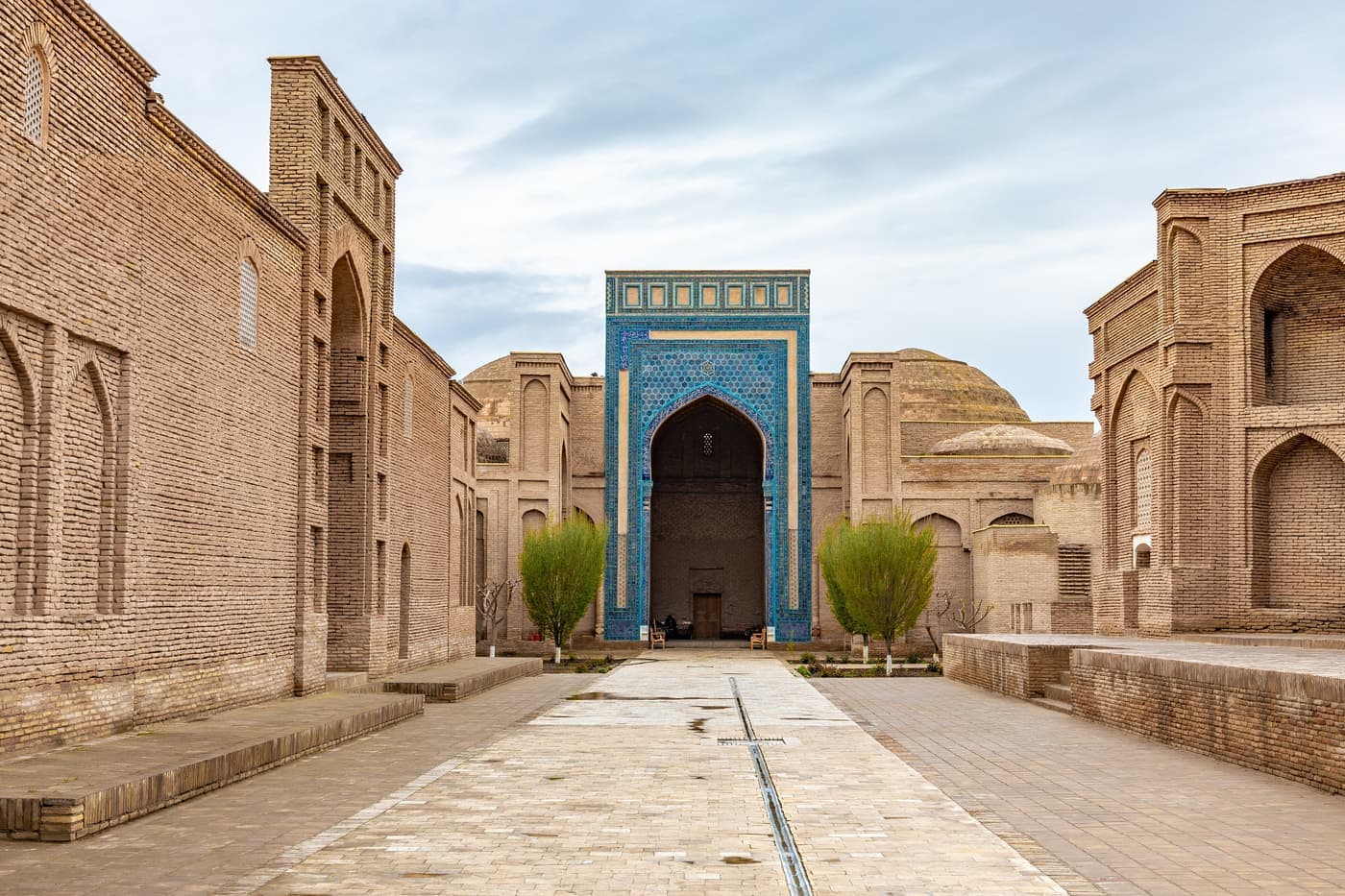
You are at Sultan Saodat, on the outskirts of Termez, in the far south of Uzbekistan. In front of you a long, narrow courtyard runs between two rows of brick buildings and ends at a tall portal faced with blue tile. Walk slowly down the middle of the courtyard towards that portal.
This is a family burial ground. It belongs to the Sayyids of Termez, a family honoured as descendants of the Prophet Muhammad. "Sayyid" is the title given to such descendants, and the name Sultan Saodat is usually explained as "sultan of the sayyids". The founder of the line in Termez is named as Hasan al-Amir. That descent is a matter of tradition and belief rather than something a historian can prove, and it is the reason the place is still visited as a shrine.
The ensemble was not built at one time. It grew, tomb by tomb, over several centuries, up to the 17th century. Sources disagree about when it began: some date the oldest buildings to the 10th century, others to the 12th.
Those oldest buildings are at the far end, where you are heading. Two square, domed mausoleums stand side by side, and between them is a deep arched hall, an iwan, which joined them in the 15th century and served as a memorial mosque. The blue-tiled portal you saw from the entrance is the front of that iwan.
Gallery


