
Gur-Emir Mausoleum
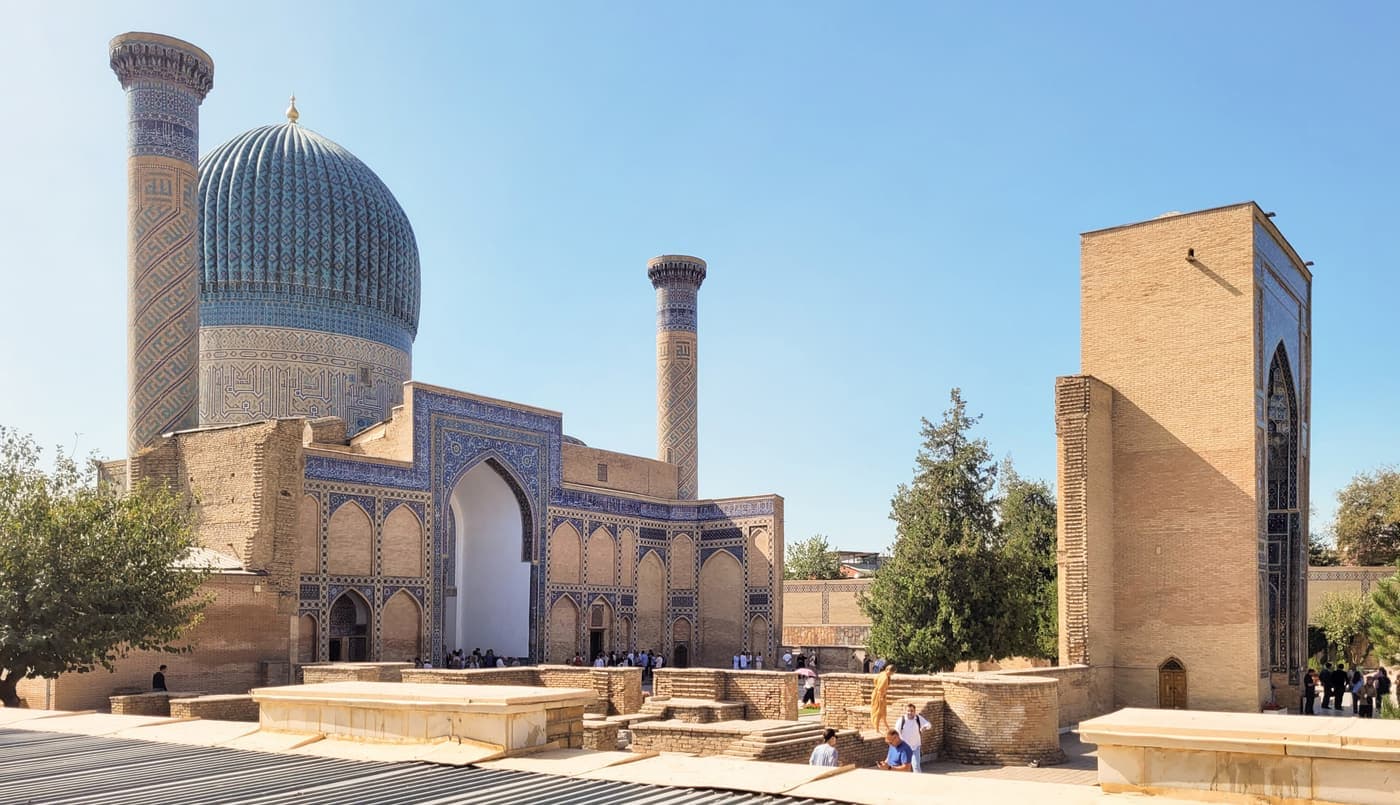
The ribbed blue dome over the tomb of Timur, begun in 1403 for his grandson and now the burial place of his dynasty.
Listen while you walk
This guide plays in the language you selected.
Audio recording coming soon
The recording for this language has not been added yet. The full script is below — you can read it now and the audio will appear here as soon as it is uploaded.
Script
You are in front of Gur-Emir, the mausoleum of Timur, in Samarkand. Step back far enough to see the whole composition: an entrance portal, a courtyard behind it, and beyond that the tall drum and the ribbed blue dome.
The name is Persian and means "tomb of the ruler". Timur, the conqueror known in Europe as Tamerlane, did not plan it for himself. He began it in 1403 for his grandson and chosen heir, Muhammad Sultan, who had died that year. The building was finished in 1404.
Timur died in 1405, on campaign in winter. He had prepared a tomb for himself in his home town of Shakhrisabz, but the mountain passes were closed by snow, and he was buried here instead. Later his sons Shah Rukh and Miran Shah, his grandson Ulugh Beg and his spiritual teacher Mir Said Baraka were laid here too. A building made for one prince became the burial place of a dynasty.
Look first at the dome. It is about 15 metres across and about 12.5 metres high, and its surface is drawn into deep ribs covered in tile of two blues. Below it, a band of very large Arabic script runs around the drum. This outline, a bulbous dome on a tall drum, was repeated by later builders far beyond Samarkand, and it is often named among the forerunners of the Mughal tombs of India.
Gallery


