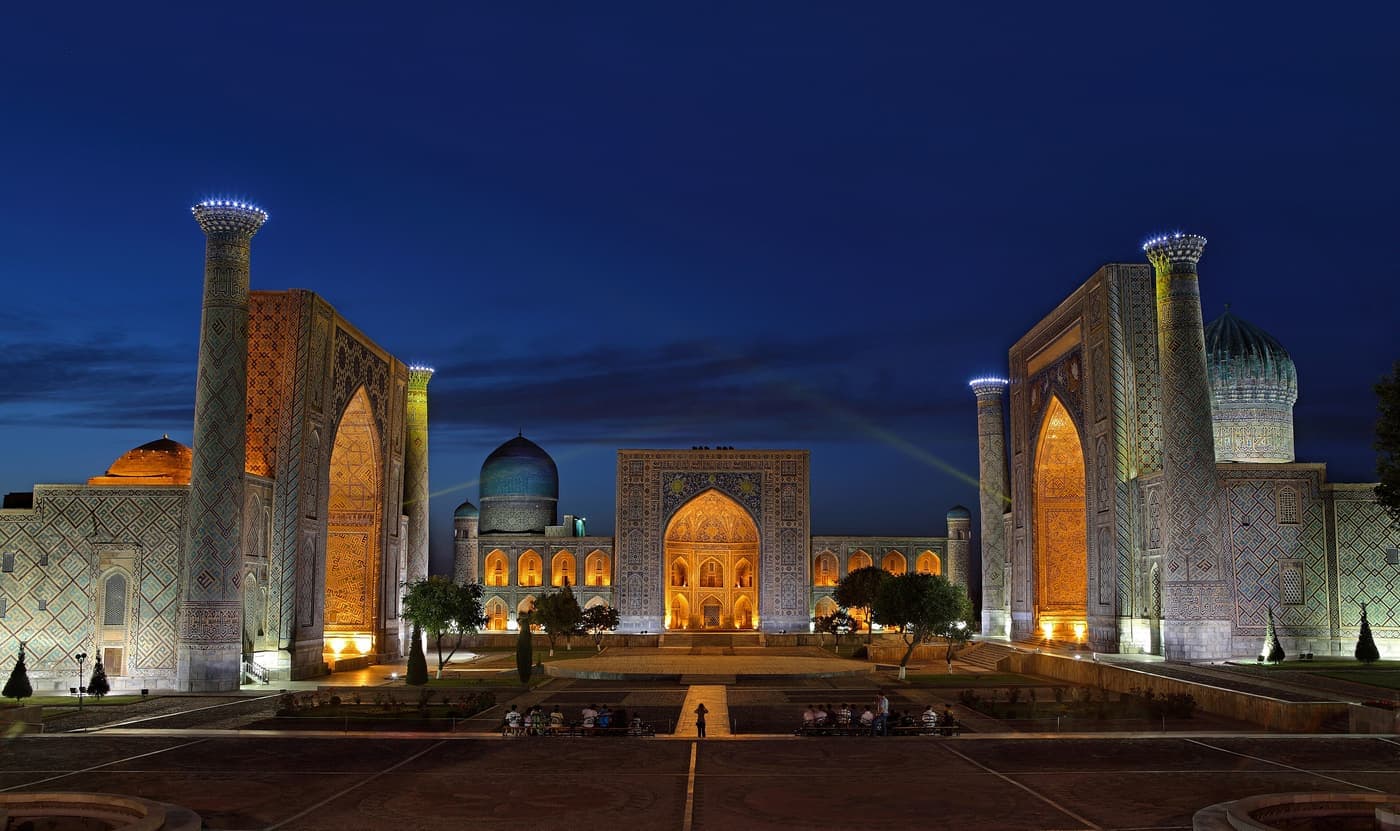
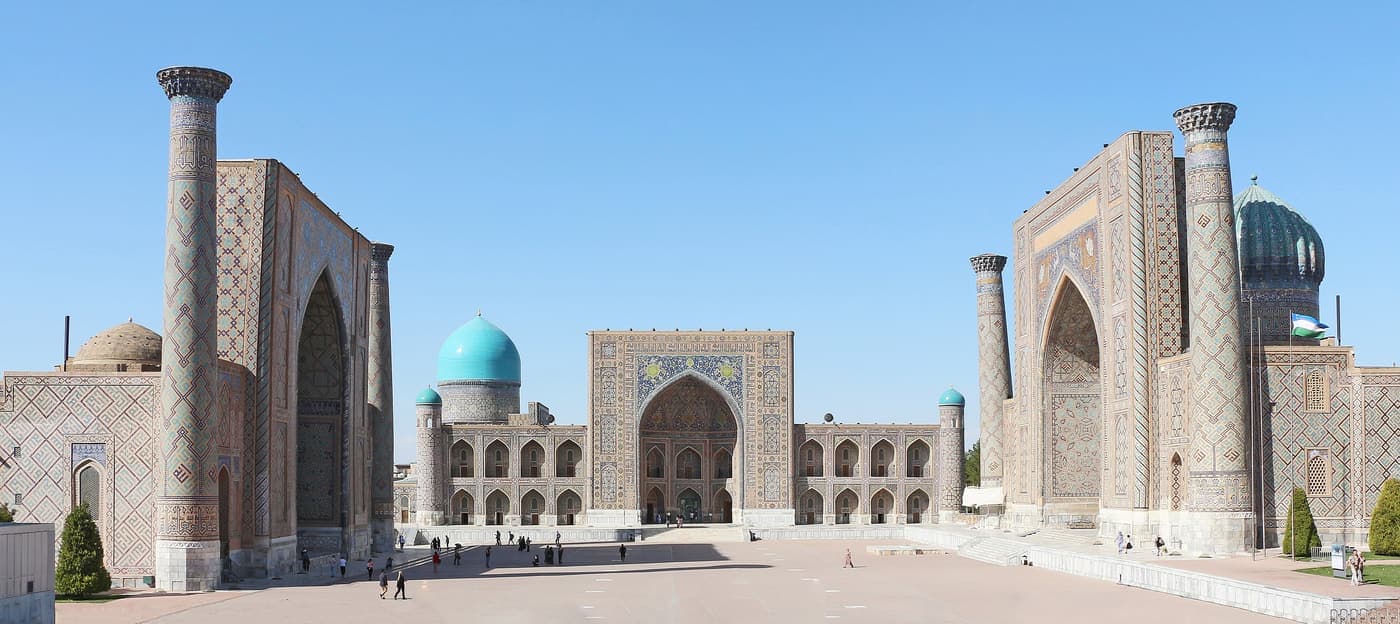
Registan Ensemble, Samarkand
Three madrasas built between 1417 and 1660 face one another across the square at the centre of old Samarkand.
Listen while you walk
This guide plays in the language you selected.
Audio recording coming soon
The recording for this language has not been added yet. The full script is below — you can read it now and the audio will appear here as soon as it is uploaded.
Script
You are standing on the Registan, the square at the centre of old Samarkand. Three madrasas, colleges of Islamic learning, close it on three sides, and the fourth side is open towards you. Stand in the middle of the open side so that all three are in view at once.
The name is Persian and means "place of sand". This was the city's main public square. Under Timur, who ruled from 1370 to 1405, it was a trading ground, and it took on its formal character under his grandson Ulugh Beg.
The oldest building is on your left: the Ulugh Beg Madrasa, built between 1417 and 1420. Ulugh Beg ruled Samarkand and was an astronomer, and the stars set in tile above the great arch are a reminder of that. A local tradition, which is better taken as a legend than as a record, says that he lectured here himself.
Opposite it, on your right, is the Sher-Dor Madrasa, built between 1619 and 1636 on the orders of Yalangtush Bahadur, the governor of Samarkand. Its name means "bearing lions". Look up at the corners of the arch: two big cats, striped like tigers, chase white deer, and behind each one rises a sun with a human face. Pictures of living creatures are rare on religious buildings in this region, which is why this portal is so well known.
Gallery