
Ak-Saray Palace
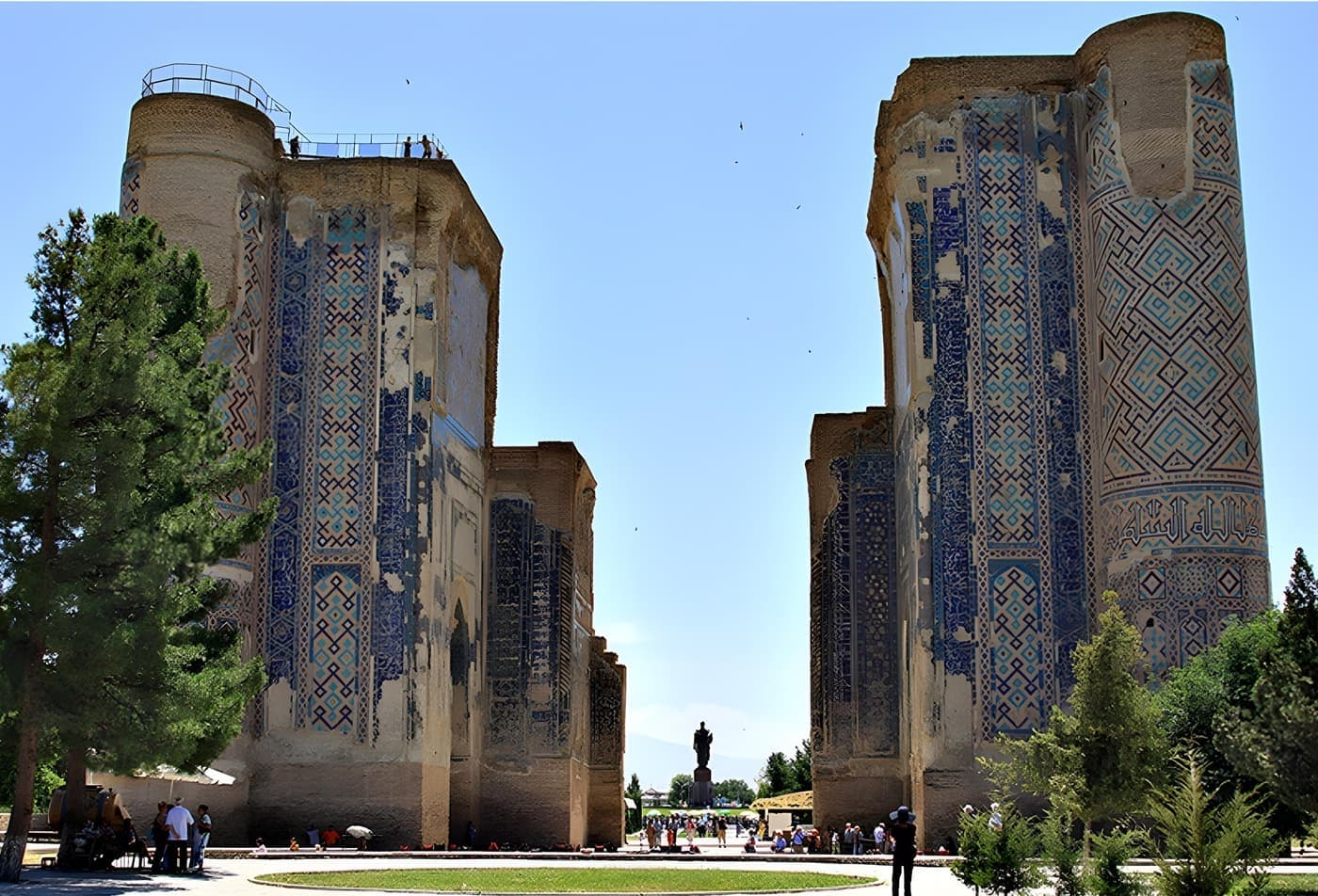
Two tiled pylons about 38 metres high are what remains of the palace Timur built in his home town from 1380 to 1404.
Listen while you walk
This guide plays in the language you selected.
Audio recording coming soon
The recording for this language has not been added yet. The full script is below — you can read it now and the audio will appear here as soon as it is uploaded.
Script
You are in Shakhrisabz, the town where Timur was born, standing before what is left of his palace, Ak-Saray. Two enormous towers of brick and tile rise in front of you with open sky between them. Stand back on the axis of the park so that you can see both at once.
The name means "white palace". "White" here is usually understood as "noble" or "splendid" rather than as a colour, since the building was covered in blue, turquoise and gold.
Timur ordered the palace in 1380, and work went on for 24 years, until 1404. What you are looking at is not the palace itself but its gateway. The two towers are the pylons of the entrance portal. They stand about 38 metres high, and the arch that once joined them had a span of about 22 metres. That arch fell long ago, and so did everything that lay behind it: courtyards, reception halls and living quarters.
We have an eyewitness. In 1404 the Spanish ambassador Ruy González de Clavijo passed through on his way to Timur's court and described the palace. He noted that, after more than twenty years, the work was still not finished.
Gallery


