
Hazrati Imam Complex
Tashkent's religious centre: a 16th-century madrasa and mausoleum, later mosques and a large mosque added in 2007.
Listen while you walk
This guide plays in the language you selected.
Audio recording coming soon
The recording for this language has not been added yet. The full script is below — you can read it now and the audio will appear here as soon as it is uploaded.
Script
You are in the Hazrati Imam complex, in the old part of Tashkent. Around a wide paved square stand a madrasa, a mausoleum, several mosques and a library. Stand near the middle of the square and turn slowly; the buildings span about five centuries.
"Hazrati Imam" means "the holy imam". The imam in question is Abu-Bakr al-Kaffal al-Shashi, a scholar of the tenth century who was born in Tashkent, which was then called Shash. He was known as a jurist and also, tradition says, as a master locksmith; "Kaffal" means "locksmith". People in Tashkent often shorten the name of the place to Khast-Imam.
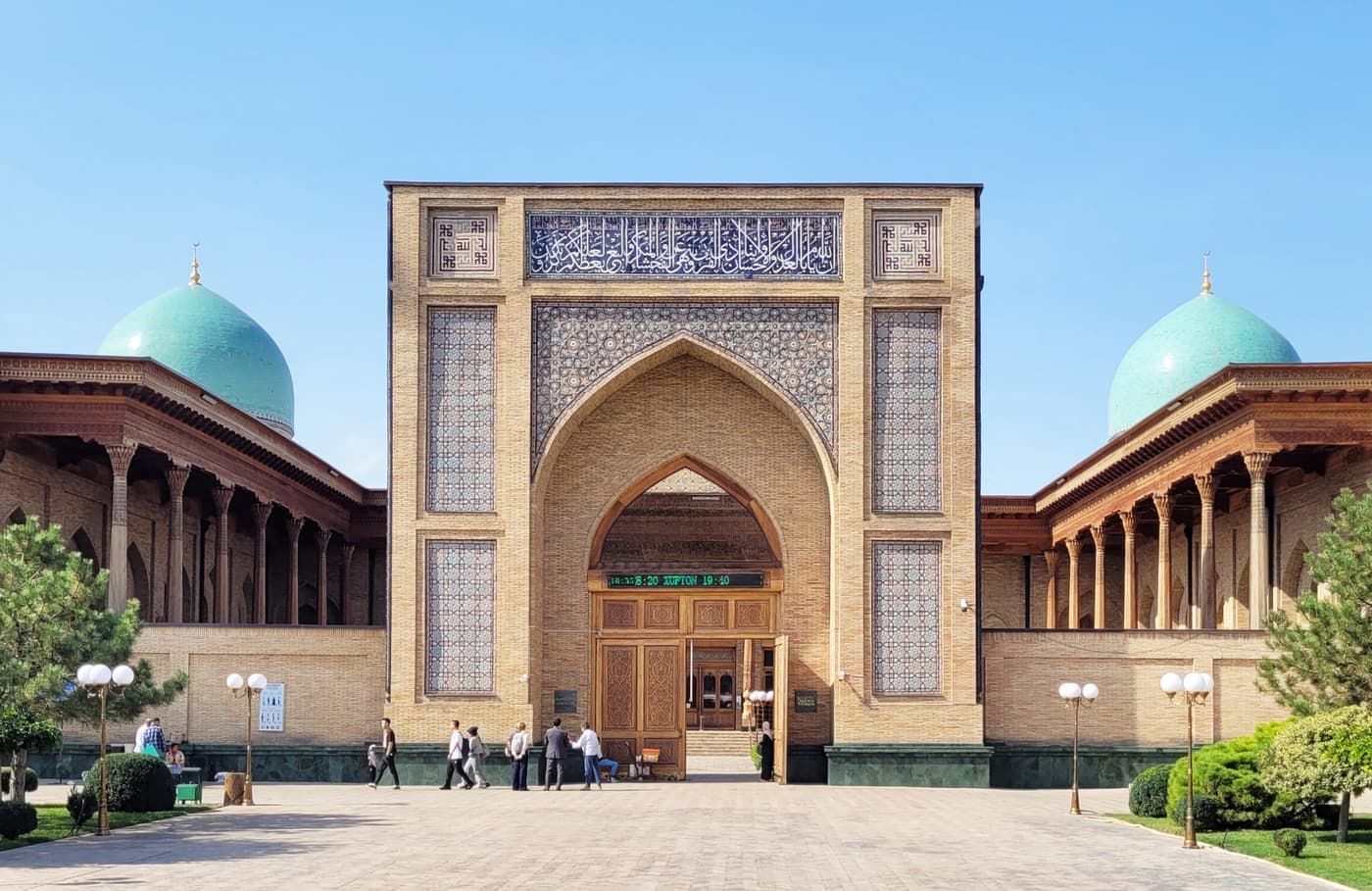
Begin with the oldest buildings. The Barak-Khan Madrasa, with its tall tiled portal and two turquoise domes, dates from the sixteenth century; the years usually given are 1531 to 1532. A short walk away is the mausoleum of Kaffal al-Shashi himself, built in 1541 to 1542 over his grave. Both are attributed to the same architect, Ghulam Husayn.
Next come the buildings of the nineteenth century. The small Muyi Muborak Madrasa was built in 1856 to 1857. Its name means "the blessed hair", after a relic said to be a hair of the Prophet Muhammad. Near it stands the Tilla Sheikh Mosque, also of the nineteenth century.
Gallery


